CXMT expands capacity and customer base, but Samsung and SK hynix retain edge in manufacturing efficiency
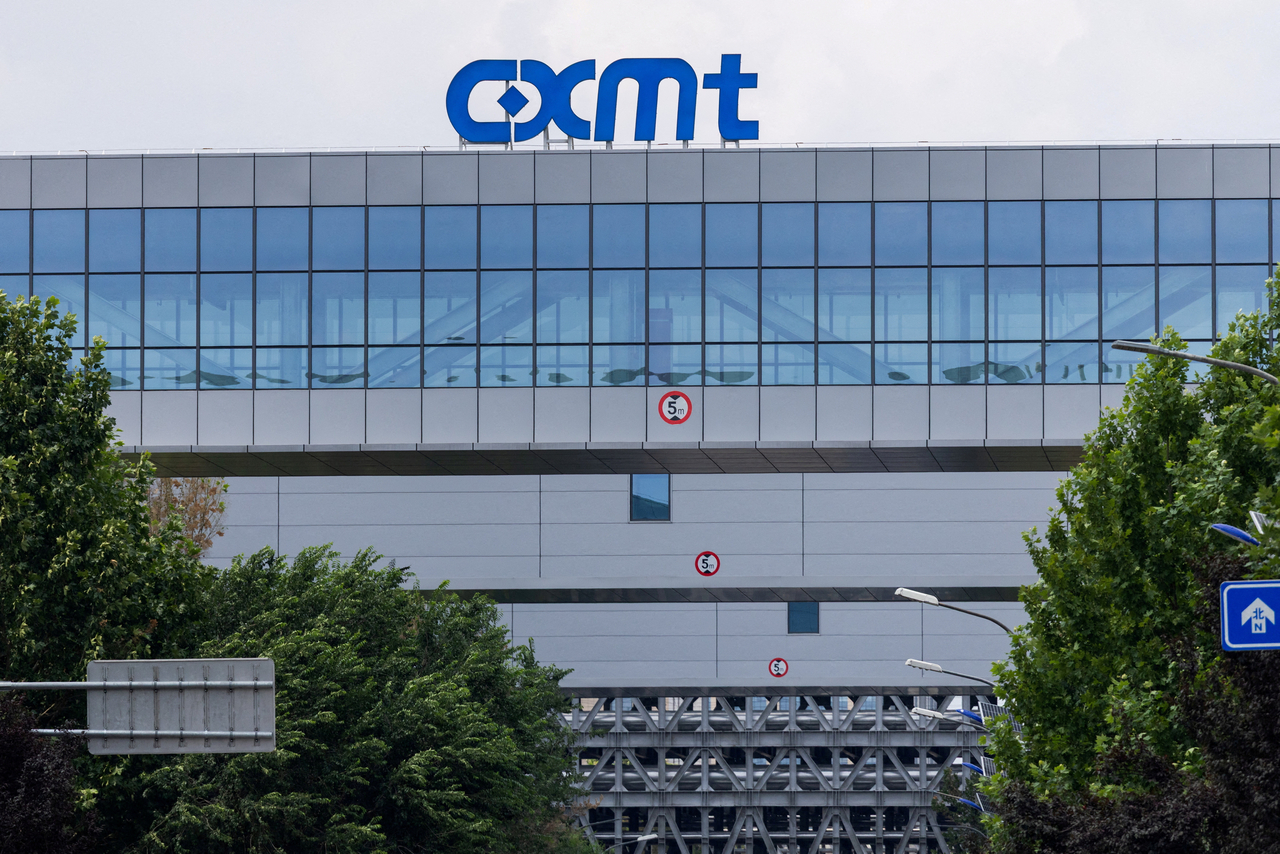
China's largest DRAM maker, ChangXin Memory Technologies, is planning to introduce a new generation of server memory by year-end, but its expanding production capacity and growing customer base may pose a bigger threat to Korean chipmakers than its latest technological breakthrough.
CXMT President Cao Kanyu said at a semiconductor conference in Shanghai on Oct. 10 that the company plans to introduce a DDR5 registered dual in-line memory module, or RDIMM, built on a 4F-squared cell architecture by the end of 2026, according to market researcher TrendForce.
The architecture could shrink individual memory cells by roughly one-third compared with conventional 6F-squared designs, assuming the same minimum feature size. CXMT says its proprietary vertical surrounded gate transistor technology increases density while reducing current leakage.
The announcement rattled investors. Samsung shares plunged 7.39 percent and SK hynix fell 10.09 percent on Tuesday, although a broader selloff driven by concerns over AI investment also weighed on the market.
Yet industry experts say the technology alone is unlikely to threaten Korea's memory leadership anytime soon.
Smaller chips, bigger questions
The 4F-squared architecture promises higher memory density, but smaller cells do not necessarily mean cheaper or more competitive chips.
Actual cell size depends on both architecture and manufacturing technology. A 6F-squared chip built on a more advanced process could achieve comparable or even smaller dimensions.
Samsung has already demonstrated a working 16-gigabit 4F-squared DRAM prototype using vertical transistors and wafer-to-wafer hybrid bonding. Unveiled at the International Solid-State Circuits Conference in February, the design could yield more than 20 percent more chips per wafer under identical design rules.
SK hynix has also presented research on vertical-gate 4F-squared memory, including ways to improve data retention and reduce electrical interference.
When asked Wednesday at a semiconductor exhibition in Seoul whether Samsung was developing 4F-squared technology, Device Solutions Chief Technology Officer Song Jai-hyuk replied, "Yes."
"We're working hard on it," he added, without specifying a production timetable.
The bigger obstacle is manufacturing economics. More complex structures, additional processing steps and low yields could wipe out the cost benefits of smaller cells.
"What matters with 4F-squared isn't simply how much smaller the cells are, but how much it costs to produce each usable bit of memory. Cutting the cell area by a third doesn't necessarily translate into lower manufacturing costs," an industry source said.
"If additional processing steps or poor yields push costs higher, the technology could actually become more expensive. That's why Samsung and SK hynix have been cautious about moving into mass production. Even if CXMT launches a product first, its market impact will be limited unless it can prove the economics work."
Park Jae-geun, a distinguished professor of semiconductor engineering at Hanyang University, questioned whether CXMT could move into mass production this year.
"Developing a technology and mass-producing it are two entirely different things," Park said. "It would be practically impossible for CXMT to mass-produce this product within the year."
Lee Jong-wook, a senior analyst at Samsung Securities, agreed that commercialization remains difficult.
"The barrier to commercializing 4F-squared is not simply whether a company has the design capability. The key is whether it can overcome current leakage and secure mass-production capabilities," Lee said.
CXMT has disclosed neither the manufacturing process nor the capacity, speed or yields of its planned product. Server memory must also undergo rigorous reliability testing and customer qualification before commercial adoption.
China's bigger threat: Scale and customers
While CXMT's technology remains unproven at commercial scale, its manufacturing and financial expansion is already underway.
The company raised 57.92 billion yuan ($8.66 billion) in its July listing on Shanghai's STAR Market, the largest initial public offering in Asia this year. The proceeds, alongside longstanding government support, will help finance production expansion and research.
CXMT is building new fabrication plants in Shanghai and Hefei. According to Reuters, the projects could more than double its monthly wafer capacity to over 600,000 if completed as planned.
Its global DRAM revenue share rose to 9.5 percent in the second quarter from 7.6 percent in the first, according to TrendForce. That placed CXMT fourth behind Samsung at 39.4 percent, SK hynix at 24.9 percent and Micron at 23.3 percent.
The gains came amid a 59.5 percent surge in industrywide revenue as memory prices climbed.
More importantly, CXMT is securing major customers.
Reuters reported that the company signed a supply deal worth more than $3 billion with Tencent in June, followed by a five-year agreement exceeding $7 billion with ByteDance in July.
Those contracts do not guarantee demand for its future 4F-squared products. But relationships with major Chinese technology companies, reinforced by Beijing's semiconductor self-sufficiency drive, could provide a ready market for new server memory.
Meanwhile, Samsung and SK hynix have increasingly prioritized high-bandwidth memory, or HBM, and advanced server DRAM to capitalize on the AI boom.
That shift has tightened conventional memory supplies, creating opportunities for Chinese competitors.
The economics are also changing. TrendForce found that revenue per wafer from 64-gigabyte DDR5 server RDIMMs surpassed HBM in the first quarter, with the server modules also delivering stronger estimated profitability.
"For Samsung and SK hynix, prioritizing HBM makes sense from a profitability standpoint. The problem is that Chinese suppliers are using this period to expand their conventional DRAM capacity and customer base," the industry source said.
"If the market swings back into oversupply, Korean companies could find themselves having to defend their traditional DRAM business while maintaining HBM production. They would have to decide whether to allocate capacity back to lower-margin products or give up some market share."
For now, tight memory supplies are working in CXMT's favor. Reuters reported in July that the company had charged some Chinese customers more than Samsung's roughly $1,240 price for comparable 64GB DDR5 server modules, giving it room to absorb higher production costs while expanding capacity.
But that advantage could fade when supply catches up with demand. US restrictions on advanced chipmaking equipment remain a major hurdle, and CXMT has yet to demonstrate that its new architecture can deliver competitive manufacturing costs at scale.
Samsung and SK hynix still lead in technology and manufacturing. The bigger risk is that CXMT is using the current boom to build the capacity and customer relationships it will need to challenge them when the market turns.
yeeun@heraldcorp.com